AI doesn’t affect every sector the same way.
Each industry faces unique risks, regulations, data sensitivities, and ethical expectations—so AI governance must be sector-specific, context-aware, and risk-driven, not one-size-fits-all.


One technology. Many realities
AI reshapes industries in fundamentally different ways—exposing unique risks, regulatory obligations, and ethical challenges.

Education

Health

Finance

Environment

Humanitarian

Government
Responsible AI Across Sectors
Learn how different sectors can govern AI effectively through clear safeguards, accountable practices, and evidence‑based controls. These tailored approaches help organisations deploy AI responsibly while protecting people, upholding trust, and meeting sector‑specific expectations.
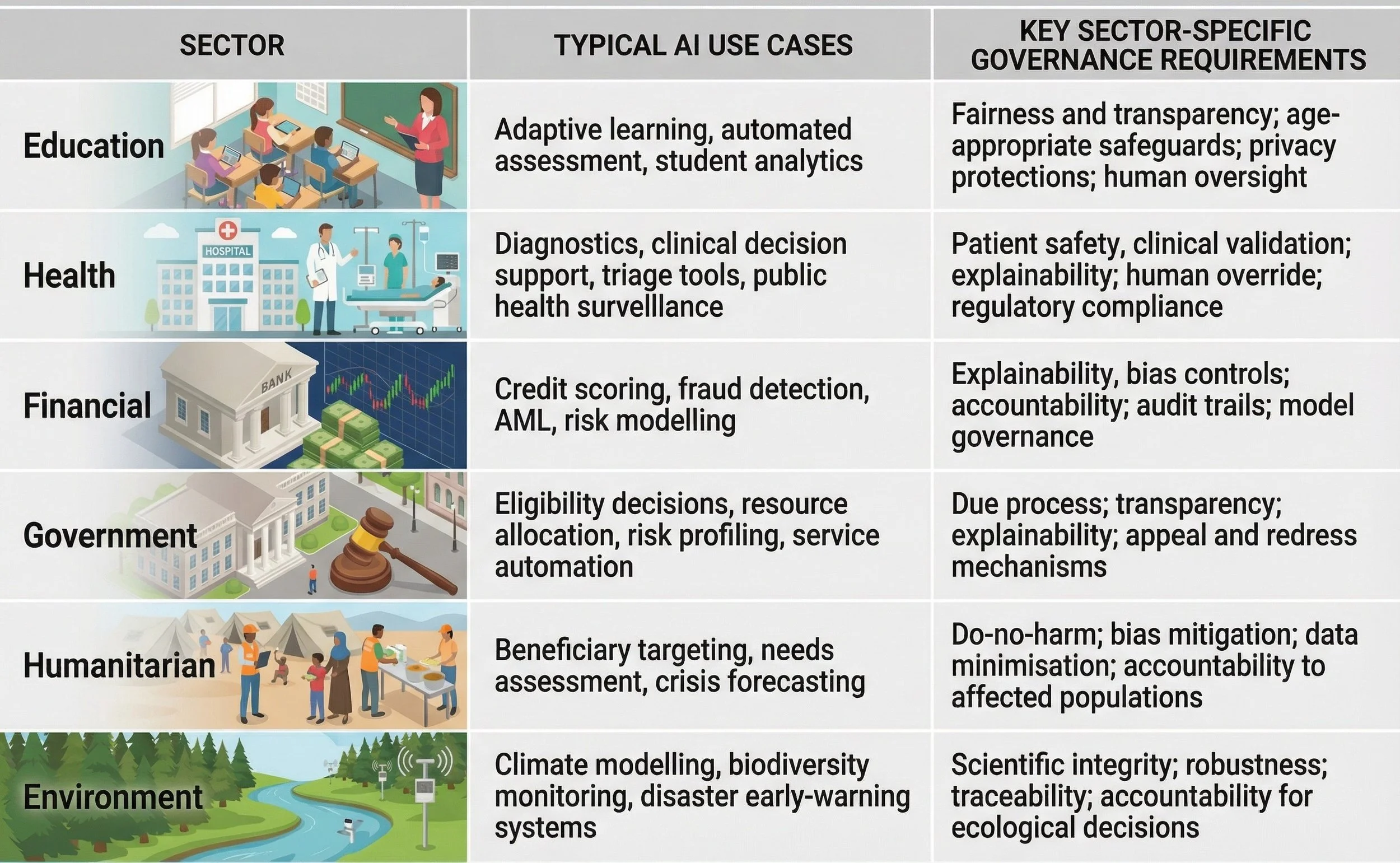
Regulatory expectations continue to evolve, so AI systems must be designed and monitored in ways that adapt to new legal, safety, and oversight requirements as they emerge.
Use‑case specifications matter—because clearly defining how AI will be used directly shapes the governance requirements needed to ensure it is safe, ethical, and fit for purpose
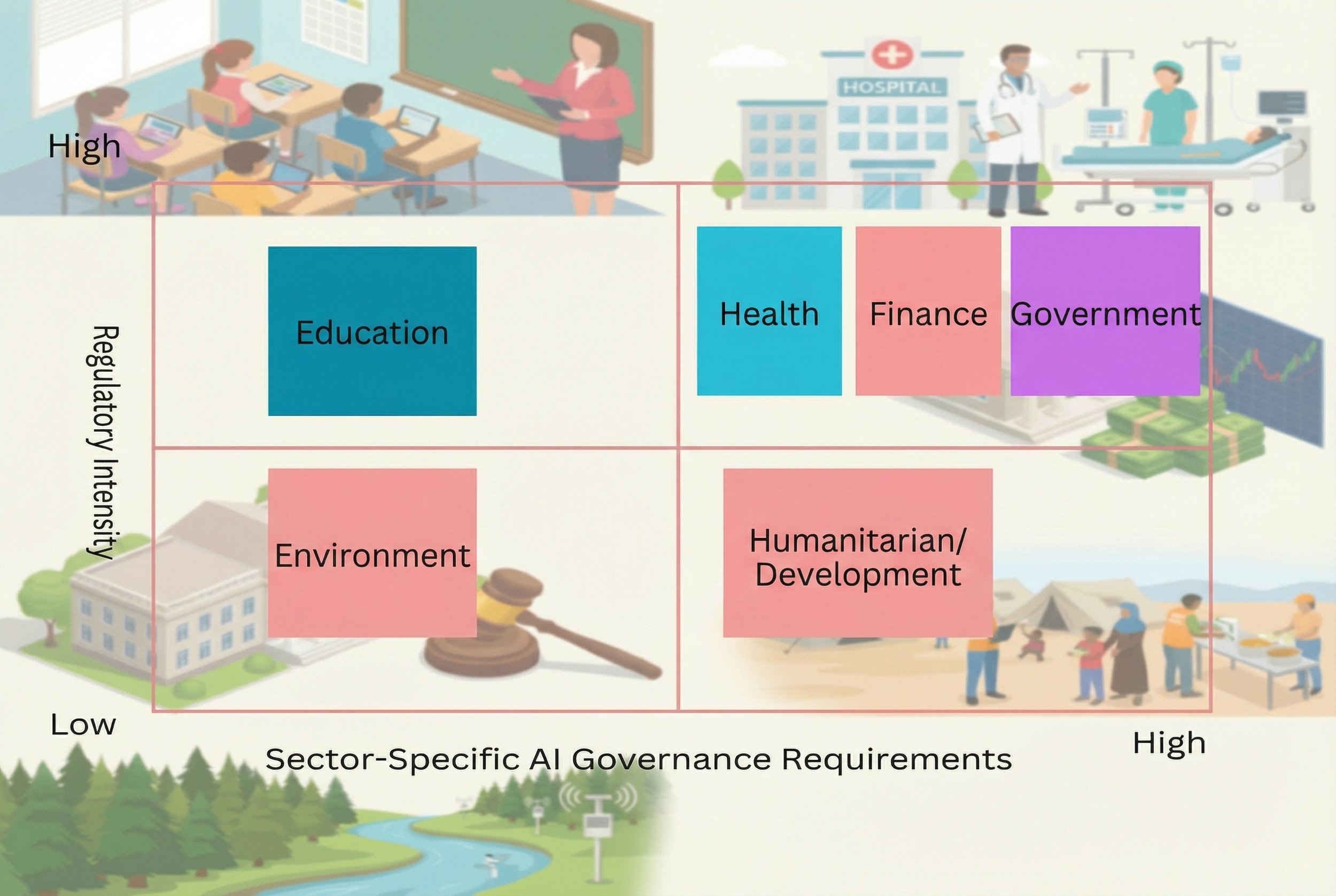
Education AI is a cognative Scaffold

-
Student Agency & AI Literacy: Prevent cognitive dependency; teach students to critique AI outputs.
Digital & Cultural Equity: Protect linguistic and cultural diversity; avoid homogenised content.
Right to a Fresh Start: Limit long‑term profiling; reset learning data to avoid "sticky labels."
Child Protection: Ban emotion recognition and any form of behavioural or social scoring.
-
Prevent Deskilling: Require progressive disclosure (hints, scaffolds, partial solutions).
EU High‑Risk Classification: Admissions, grading, and placement systems fall under high‑risk AI.
Safety Standards: Embed contextual filtering and age‑appropriate safeguards (e.g., DfE‑aligned).
Prohibited Practices: No social scoring, behaviour prediction, or emotion‑tracking in classrooms.
-
Legal Compliance: Parental opt‑in for under‑13 data; strict controls on student records.
Governance Structures: CAIO roles, academic oversight boards, and documented human review.
Procurement Governance: Require vendor transparency on data provenance and bias controls.
How AI Governance Policies & Tools Add Value in Education
Decide where AI is safe
Risk maps identify safe vs. sensitive uses - such as low-risk grammar feedback vs. high-risk automated grading
Impact templates show who is affected and how - impact on students, teachers, and vulnerable groups
Vendor scorecards compare privacy and safety - a checklist that compares privacy, security and safety

Test AI safety for students
Sandboxes trial tools before classrooms - controlled environments to experiment before exposing students
Red‑team exercises expose bias and harms - structured “stress “ scenarios to uncover risks
Checklists guide simple go/no‑go decisions - Easy‑to‑use approval checklists guide educators
Keep institutions accountable & transparent
AI registers list tools, owners, risks - A central AI register lists approved tools, risk levels, and the responsible owner
Clear ownership defines roles and actions - Explicit responsibility for risk management actions
Documentation - Keeping simple, structured documentation such as decision logs, and vendor assessments

Health AI is unique because its decisions directly influence people’s lives and well‑being
AI now shapes clinical decisions and access to care; oversight must be embedded where care is delivered. Cross‑sector AI principles aren’t enough; healthcare needs lifecycle controls aligned to medical standards, regulatory pathways, and duties of care.
Clinically governed AI brings these elements together by ensuring that AI systems are evaluated, deployed, and monitored with sound processes, within evidence‑based, safety‑driven, and accountability‑anchored structures.
An example of a Clinically Governed AI lens
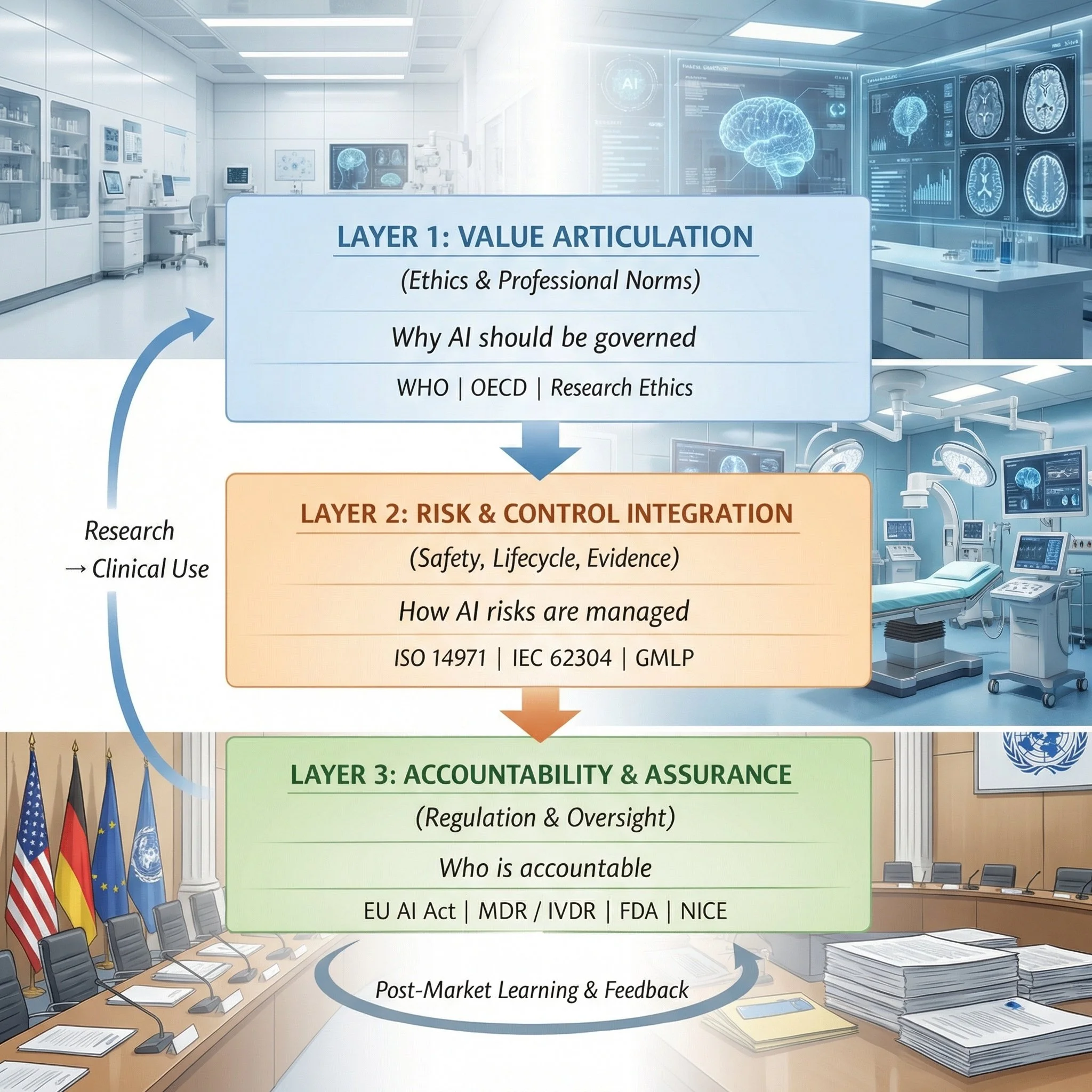
Ethical Layer
Ensure that AI‑enabled health research upholds WHO principles of human rights, transparency, fairness, accountability, safety, and inclusiveness, integrating ethical research principles related to research integrity, responsible data use, scientific rigor, and participant protection.
Risk & Control
Ensure that medical AI systems follow structured health‑specific risk management (ISO 14971), apply safe and traceable software lifecycle controls (IEC 62304/62604), and adhere to Good Machine Learning Practice for robust and reliable performance.
Accountability & Assurance
Ensure that AI‑enabled health technologies meet EU AI Act high‑risk oversight, comply with MDR/IVDR safety and lifecycle requirements, align with FDA total‑product‑lifecycle and GMLP expectations, and demonstrate clinical value, safety, and real‑world effectiveness consistent with NICE evaluation standards